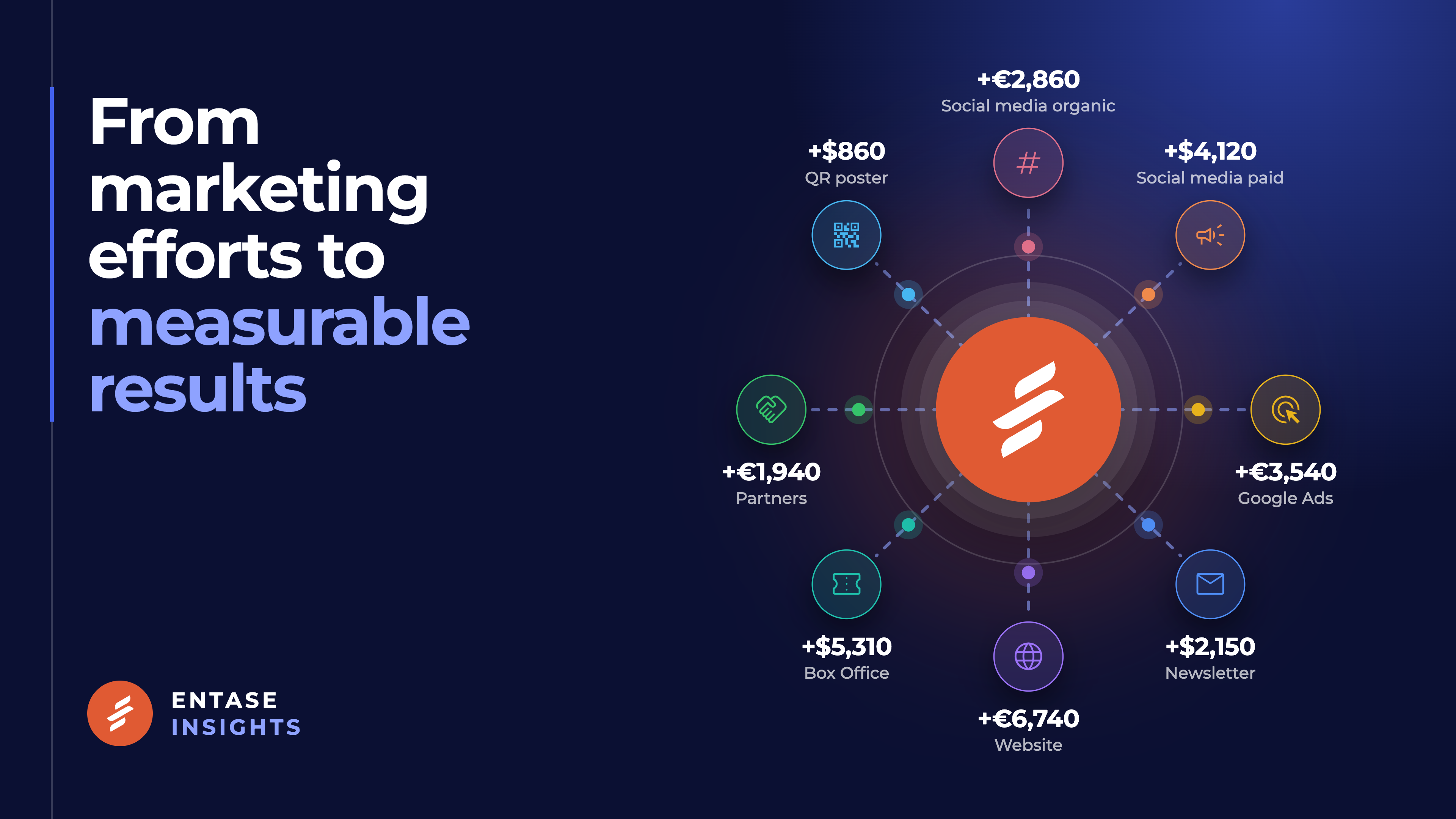
Promoting an event takes more than announcing it. Social media campaigns, email newsletters, paid advertising, local partnerships, and word of mouth all play a part in reaching potential attendees.
But running campaigns without tracking their results is largely guesswork. You invest time and money in different activities, and at the end, you look at the total tickets sold without knowing which efforts actually made a difference.
A campaign that generates thousands of clicks might produce fewer bookings than a newsletter sent to a few hundred loyal customers.
Connecting your marketing activities to actual ticket sales is what turns promotional efforts into measurable results. And with the right tools and a little preparation, it doesn't have to be complicated.
1. Identify your marketing channels
Start by identifying the different ways people discover and purchase tickets for your events.
These might include:
- Social media – organic posts and paid campaigns on Facebook, Instagram, TikTok, or other platforms.
- Email marketing – newsletters, announcements, and promotional messages to your audience.
- Partners and affiliates – local media, influencers, sponsors, and organizations promoting your events.
- Your website – visitors who discover your events through search engines or navigate directly to your website.
- Offline promotion – printed materials, local advertising, and in-person recommendations.
Not every channel needs the same level of tracking. Focus first on the activities where you're investing the most resources or where understanding the results would help you make better decisions.
It's also important to distinguish between where customers discover an event and where they complete their purchase. Someone might see your Instagram advertisement but eventually buy a ticket at the box office.
Both pieces of information are valuable, but they tell different stories.
2. Give every campaign its own identity
Knowing that sales came from Instagram is useful. Knowing which Instagram campaign generated them is even better.
Imagine you're organizing a concert and promoting it through three different activities: a paid Instagram campaign, an email newsletter, and a local media partnership.
If all three use the same ticket link, you might see sales increase without being able to identify which activity contributed.
A better approach is to give each campaign its own identifiable source.
In Entase, you can do this using Segments – color-coded labels with unique identifiers that help you group ticket sales by campaign, distribution partner, or any other meaningful distinction.
For example, you could create:
ig-concert-nov– Instagram advertising campaignemail-concert-nov– Email newsletterpartner-concert-nov– Local media partnershipboxoffice-concert-nov– Walk-up box office sales
Segments can be attached to links or selected manually during a box office checkout. When a sale is made, Entase records the associated segment, allowing you to analyze orders, revenue, and ticket sales for each source.
Instead of looking at one combined sales figure, you can compare individual initiatives across a single event or your entire program.
The important part isn't creating dozens of labels. It's creating meaningful distinctions that help you answer real business questions.
For setup instructions, see Creating and managing segments.
3. Turn your links into tracking tools
Once your segments are created, the next step is connecting them to your promotional activities.
Entase allows you to generate short links that lead to an event page or directly to checkout. Each link can be associated with a segment, so purchases made through it are automatically attributed to that source.
This makes it easy to:
- Share a dedicated link for each advertising campaign.
- Include a separate tracking link in every newsletter.
- Give promotional partners their own identifiable links.
- Use unique links in QR codes on printed materials.
For example, instead of asking every partner to share the same event URL, give each one a separate segmented link. You'll then be able to compare the sales generated through those links without manually tagging orders afterward.
For offline transactions, box office staff can select the appropriate segment during checkout, bringing those sales into the same reporting structure.
You can find the setup instructions in Short links and social sharing.
4. Understand where sales actually happen
Campaign tracking tells you which promotional sources are associated with purchases. But understanding where transactions happen adds another important layer.
Entase automatically records sales Channels and Operators for each order.
Channels distinguish between online purchases and physical box office transactions. Operators provide additional information about the website associated with an online order or the staff member handling a box office sale.
Unlike segments, this information is recorded automatically, without additional configuration.
Together, these dimensions give you a more complete picture.
For example, a particular segment might generate purchases through different sales channels. Or you might discover that a significant portion of your revenue comes from box office transactions, even though most of your marketing happens online.
Combining these perspectives helps you understand not only which promotional activities are associated with sales, but also how customers complete their purchases.
For more details, see Channels and operators.
5. Measure results, not just activity
Once your campaigns are running, it's time to look beyond impressions, clicks, and engagement.
Start with two basic measurements: how many orders each campaign generated and how much revenue those orders brought in.
Consider this example:
| Campaign | Orders | Revenue | Cost |
|---|---|---|---|
| Instagram advertising | 40 | €1,200 | €400 |
| Email newsletter | 35 | €1,050 | €50 |
| Local media partner | 20 | €600 | €150 |
At first glance, Instagram seems to be the clear winner, generating the most orders and revenue.
But comparing revenue against campaign costs reveals a different picture.
The email newsletter generated €21 in ticket revenue for every €1 spent, compared with €3 for Instagram advertising and €4 for the media partnership.
That doesn't necessarily make email the best channel. Paid advertising might introduce your event to entirely new audiences, while newsletters typically reach people who already know your organization.
The goal isn't simply to identify the cheapest source of sales. It's to understand the role and effectiveness of each marketing activity.
Entase Statistics gives you the sales data behind these comparisons, while campaign costs can be taken from your advertising platforms, agency reports, or internal budgets.
6. Explore the bigger picture with Statistics
Individual campaign results are useful, but the real value often comes from comparing them across events, channels, and time periods.
Does your audience respond better to email announcements or paid advertising? Which campaigns generate early bookings? Which partners consistently bring customers? Do certain promotions perform better for particular types of events?
The Statistics section in Entase brings these perspectives together.
You can explore sales performance across:
- Channels – compare online and box office sales.
- Operators – identify the websites or box office staff associated with orders.
- Segments – evaluate campaigns, distribution partners, and individual sales sources.
- Events – see which events generate the most orders and revenue.
- Coupons – measure sales associated with specific promotional codes.
All these dimensions share the same underlying data, and cross-tab filtering allows you to explore their relationships without jumping between disconnected reports.
For example, selecting a particular segment lets you examine how its revenue developed over time, which events it contributed to, and the breakdown of its ticket sales.
You can also share a link to a filtered statistics view with co-organizers, sponsors, or marketing agencies, giving them access to the relevant insights without providing full administrative access.
For more information, explore Work with statistics and Sharing statistics.
7. Turn your findings into action
Collecting data is only useful when it influences what you do next.
If email marketing consistently produces strong results, consider investing more in growing and engaging your mailing list.
If a particular promotional partner generates valuable sales, explore a longer-term collaboration.
If paid advertising performs well during the first days after an event announcement but slows down later, experiment with adjusting your advertising schedule.
And if one campaign underperforms, don't immediately abandon the channel. Try changing the message, audience, creative materials, or timing before drawing conclusions.
Remember that tracking has limitations. A customer might discover your event through an advertisement, visit your website several days later, and purchase through a different link. The recorded sales source won't necessarily capture every interaction that influenced their decision.
Use attribution to identify patterns and make informed decisions, rather than treating every figure as an absolute measure of marketing impact.
Make your next campaign smarter than your last
You don't need a large marketing budget or a dedicated analytics team to start measuring what works.
Before launching your next campaign, identify your promotional activities, create the corresponding segments, and generate trackable links for each source. Make sure your box office team knows when to apply segments to in-person purchases.
As sales come in, use Statistics to compare performance. Review the results, account for your campaign costs, and apply what you've learned when planning your next event.
Over time, you'll gain a clearer understanding of your audience, which channels deserve more investment, and how to allocate your marketing resources effectively.
The goal isn't just to sell more tickets. It's to understand what drives those sales, so you can repeat what works and improve what doesn't.